


-


-

-
Search
-
Recent Posts
- Kryptowährungen Handeln Test – Wo sind kryptowährungen verboten?
- Sichere Krypto Börse – Kryptowährung wovon abhängig?
- Kryptologie Uni Ulm | Welche kryptowährungen haben potenzial?
- Scalping Kryptowährung – Wie viele kryptowährungen gibt es bei coinbase?
- Margin Trading Kryptowährungen Yahoo Finance – Warum steigen kryptowährungen so stark?
Blog Archive
June 2026 M T W T F S S « Aug 1 2 3 4 5 6 7 8 9 10 11 12 13 14 15 16 17 18 19 20 21 22 23 24 25 26 27 28 29 30 Categories
- Activities With Kids
- Adolescence
- Adulthood
- Aging
- Anger Management
- Apps
- Arts Education
- Babies
- Blog
- Books
- Boys to Men
- Breastfeeding
- Camp
- Cars
- Celebrity Dads
- Charity
- Child Development
- Children's Music Reviews
- Columns by Family Man
- Contests
- Creativity
- Dating Dad
- Death
- Divorced Dads
- Education
- Ethics
- Family Communication
- Family Man in the News
- Family Man Recommends
- Family Music
- Family Music Reviews
- Father's Day
- Featured Moms & Dads
- Film
- Food
- Free Stuff
- Friendship
- Gender
- Graduation
- Grandparents
- Halloween
- Health
- Helping Kids Understand Loss
- Holidays
- Humor
- Internet Safety
- LifeofDad.com
- Love and Courtship
- Marriage
- Morals
- Mother's Day
- Movies
- Music
- Newborns
- Over-parenting
- Parenting Stress
- Perspective
- Pets
- Politics
- Protecting Children
- Safety
- School
- Sex Ed
- Siblings
- Single Fathers
- Social Action
- Special Needs
- Sports
- Sweepstakes & Promotions
- Talking About Disasters
- Teens
- Top Ten Lists
- Travel
- Traveling With Kids
- TV
- Tweens
- Uncategorized
- Values
- Vasectomy
- Video
- What Dads Need to Know
- Work-Family Balance
Recent Comments
- Beth on The One That Ends With Hope
- Judi Feldman on The Brass Tacks of Music Education
- Fran Keer on A Road Well Traveled
- norman edelson on A Road Well Traveled
- Justin Rogan on The Gift of Boredom
- © 2026 - Gregory Keer. All rights reserved.
Evil Dad
By Gregory Keer
Following is a Halloween column that scared up some laughs a few years back. It’s back to haunt you intrepid readers, once again.
I don’t enjoy seeing car wrecks, reading about celebrity break-ups, or learning of the latest politician caught doing something illegal. But I do like witnessing other children behaving badly. I know it’s sinful, a little evil, even. That doesn’t stop the twisted inflation of my ego resulting from other parents having a similar or worse time than I usually have. Honestly, I do not wish misfortune on any parent — I just want to be there when it happens.
I didn’t always know I had this character flaw. For most of my fatherhood tenure, I’ve been too preoccupied to notice it while my own kids went through phases of throwing breakable items in grocery stores and telling friends that Santa Claus doesn’t really exist. My youngest boy, Ari, may be my biggest troublemaker. At an amusement park, the other day, he thought it was hilarious to randomly swat other grown-ups while I carried him through the crowd. I’m pretty sure he would have laughed harder should I have been punched in the nose by one of his surprised victims.
Although I know that all children misbehave at times – and that pushing boundaries can be healthy, especially when the stakes are low at the younger ages — I worry about the judgments of others who might see me as an ineffective parent. I sometimes fantasize about turning into a Dickens character, pulling my kids by the collar, and growling at them in a cockney accent, “Mind your manners, my urchins. It’s not wise to make your father look poorly.” (Actually, I did that once and my kids laughed at me).
But a recent conversation has allowed me to embrace my vampire-like desire to feed off other parents’ misery. During a basketball game for my oldest son, I watched a father on the sidelines, trying to give advice to his eight-year-old kid, who responded with, “Why should I listen to you, Daddy? You stink at shooting!”
Then, my friend Adam, a master of the witty aside, leaned toward me and said, “There’s a column for you. Write about how much fun it is to see other parents suffer.” We spent the rest of the game recounting tales from the parenting dark side. When once, as younger men, we might have shot the breeze about girlfriends, pro sports, and bad job experiences, we were now reduced to cackling gossips.
I told the story of the panicked mom who scoured a zoo in search of her missing son. When she finally found him in the dimly lit reptile center, in which she had looked twice before, she screamed, “Why did you go in here alone?” The child responded with the classic, “I don’t know.” As Mom launched the rest of her tirade, I tried to conceal my grin as other people escaped the house of snakes and the nearby baboons screamed along with the poor mother.
We talked about the father who leaped out of the stands to accuse the opposing coach of letting his players hit baseballs at his son on the pitcher’s mound. The agitated dad was just trying to be protective, but the tantrum stood out during a tee-ball game among five-year-olds who could barely tap a stationary ball. We took glee in the pain of the dad who, after overhearing his child refuse to share any of his toys, announced, “We’re really nice people. Please don’t judge us by our son.” And, in one of the more ugly examples, I noted the wicked thrill of seeing another parent get chewed out because his son bit my son, and not the other way around.
I am not proud of my primal need to feel better about my own failures by recalling the difficulties of others, but it does remind me of how absurd it is to try living up to the expectations of calm and wisdom most of us place upon ourselves. As this Halloween approaches, I won’t need a costume or candy. I’ll be the Evil Dad, feasting on the treats supplied by parents trying in vain to keep their kids in line in the dark of the night.
Coming of Age Film ‘The Way, Way Back’ is a Summer Treat
Reviewed by Gregory Keer
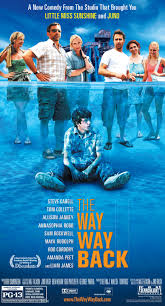 My sister and I used to sit in the way back of our parents’ Ford station wagon. Like a lot of kids did, I felt like I was on an amusement park ride, going backwards. Of course, there were those times when it was embarrassing as hell facing the driver of the car behind us, so it was good that our parents traded the wagon in before I hit adolescence.
Duncan, the 14-year-old boy at the center of the coming of age film The Way, Way Back, doesn’t have it as easy as I did. He’s sitting in the last row of a station wagon at an age when he’s trying to mature while most of the grown-ups around him act like impulsive children. Played with slow-growing confidence by Liam James, Duncan is much like I was as an adolescent — awkward but feeling older in my head than my appearance. In this truly wonderful comedy-drama, written and directed by Nat Faxon and Jim Rash (who won an Oscar for writing, with Alexander Payne, the screenplay for The Descendants), Duncan learns to make the most of a summer vacation in which his mom (Toni Collette) is dating a conflicted jerk (Steve Carell), and Duncan is worrying about a possible romance (with the character gracefully portrayed by AnnaSophia Robb) as well as concern about when he will next see his father. The kid really needs someone to take him under his wing to show him how to enjoy life in a world in which all the adults are unhappy. Cue Owen, the man-child who hires Duncan at the local water park and helps Duncan find self-worth and age-appropriate fun. Sam Rockwell is so freakin’ good as Owen, it seems high time that this dude get his Oscar nomination since he consistently colors his characters with texture and wit.
I highly recommend this film as one parents should see with their children, age 13 on up. It raises issues of family, love, and maturity in a way that isn’t heavy-handed but very honest. I saw The Way, Way Back with my wife and my way-back partner, my sister, and her husband. We all experienced it with laughs and tears and the feeling that it depicted a universal experience worth sharing with our older children.
Dads Serenade Us With “A Whole New World”
In preparation for Father’s Day, we have a new funny dad music video as those brave souls at Life of Dad give us a cavalcade of paternal types singing Alladin’s “A Whole New World.” Come on, you know you want to sing along…
Brothers Try to Take a Mother’s Day Photo
My three sons can barely do anything together at home without it involving a headlock. While they have been surprisingly good about creating greeting cards and artwork, this year, I can imagine them creating a Mother’s Day video like this, if they had to collaborate on it.
Mother’s Day – watch more funny videos
Noteworthy
By Gregory Keer
Following is a re-post of a kids Valentine’s Day column I wrote when my now 11 year old was in kindergarten. Truth be told, his writing skills still put me to shame.
Valentine’s Day is coming up and I’m already sweating over what my middle child will write on the little cards he’ll pass out to his kindergarten classmates. Most six-year-olds stick to filling out the basic TO: and FROM: blanks that accompany the cuddly bear or fluffy duck illustrations. Not my little Romeo. I figure he’ll write special sentiments to the handful of girls he fancies. I’m picturing lines such as, “I like your soft, silky hair, Jessica” and “I had a wonderful time on our playdate, Anna. Let’s do it again sometime.”
People think I’m exaggerating about Jacob’s love note writing, but he also flecks his daily speech with gold-plated words like “silky” and “wonderful” as if he’s a 45-year-old Casanova. He rarely misses paying a compliment toward females of all ages, from his peers to his teacher. He’s twice written about Mrs. Harris for the “Character Counts” descriptions he is assigned each week. These are, thankfully, sweet rather than sassy as he calls her “the nicest and best teacher in the whole world.” Then, there are the bold comments he makes to the moms he sees at the afternoon pick-up (pun intended). To one of the mothers, I heard him say, “That sweater makes your figure look good,” with an earnest smile that renders more innocent a sentence that sounds like a singles bar come-on.
While I have concerns that he’s a bit more romantically precocious than I’d like, my bigger issues rests in the fact that the little turd is showing me up. Not only does he say things to women that I wish I had thought of when I was an unattached adult, he writes the most charming notes to my wife. At least once a week, sometimes more, he draws colorful designs on index cards and any other paper he can find to go with “Thank you for being such a good Mommy” sentences. He even leaves these notes in clever locations, including Wendy’s laptop bag and under her pillow. I don’t know where he gets this emotive skill, but the bottom line is that I can’t compete with him — and that pisses me off.
Now I’ve got Wendy asking me, “Why don’t you write love notes like you used to?” I could reply with, “I don’t know, honey, why don’t you leave steamy messages on my cell phone anymore?” but her question makes me a little wistful. In our early years, I wrote Wendy all kinds of messages on post-its, stationery, and expensive artsy cards. I scribbled poems, proclamations of my undying love, and occasional ribald jokes. I planted them on the bathroom mirror, in her suitcases, and, yes, under her pillow.
Sure I hack out an occasional adoring e-mail, but these days, she’s lucky if she gets a prewritten card on her birthday. So I wonder, where did my Cyrano-like habit go? Is it there, somewhere buried beneath all the words I have to write on checks to the bank and college letters of recommendations for my students? That’s part of the reason, but another cause for the more shallow word well is that I often feel the pressure to say something new and creative, more indicative of the stage our relationship is in. Yet, I just can’t bring myself to write, “My darling, I long to ravish you amid the laundry piles and sandbox granules in our sheets” or “Our love is like a school backpack — filled with all the homework questions I’m thrilled to be answering with you.”
As rusty as I am with the practice of love note writing, I am actually more appreciative of my son’s suave skills than I am envious of them. He is unafraid of pouring out his feelings and observations into words, not yet aware of the world’s cynicism toward sentimentality. So I encourage him and help him spell “I appreciate you” and “I love you as deep as the ocean.” In turn, he spurs me on to jot a few more notes to my wife than I had been writing. They aren’t all that original or clever, but the mere presence of the letters on the paper makes them real and true.
Family Man Recommends: Children’s Music Reviews for February 2013
Reviewed by Gregory Keer
The Grammys just wrapped and, I must say, I enjoyed the primetime show immensely. I particularly loved the performance of the Black Keys with Dr. John and the Preservation Hall Jazz Band blasting through “Lonely Boy.” For the Best Children’s Recording, one of my favorite duos, the Okee Dokee Brothers, won for Can You Canoe? against a field chock full of stellar nominees.
For this short month, my children’s music reviews begin with one of the other 2012 Grammy nominees, Bill Harley, who has concocted yet another album of kid-friendly mirth and mayhem. This time, Bill is paired with Keith Munslow, who shares Harley’s hybrid status as a singer-songwriter-storyteller. The recording is called It’s Not Fair to Me and employs everything from ’60s-style rock (including surfer rock) to folk sounds in accompanying humor-drenched songs about fairness, whining, dogs, unflattering imitation, and stylistically offensive sweaters.
The Not-Its have one of the kindie-rock world’s best band names, so it makes sense for them to have one of the best recordings of this young year. KidQuake! rocks forth with a title song about the power kids generate, then speaks the truth about a “Temper Tantrum,” and recalls The Who’s pinball wizard themes with “Full Tilt.” The guitar-heavy quintet balances things nicely with vocal harmonies that vividly illustrate elements of modern families.
Rounding out the recs is Francie Kelley’s Where Do You Want to Go Today? A multi-award winner for her previous CD, Wake Up and Go to Sleep, the sweet-singing Kelley offers a globe-circling journey through songs that travel to “African Skies”, an “Irish Dream”, and the Argentine-inflected “Tarantula Tango” – a cleverly worded tune about an arachnid disrupting a backyard camp-out.
Dads Croon Mariah Carey’s “All I Want for Christmas”
Following their cover of the Little Mermaid’s “Part of Your World,” the gents at LifeOfDad.com recorded this version of Mariah Carey’s holiday chestnut, “All I Want for Christmas.” Everyone from Marines to a pop in footsie PJs unabashedly warble along in this dad music video.
Free to Laugh with “It’s OK To Do Stuff”
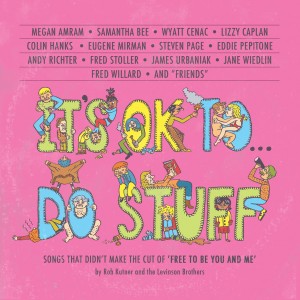 With its songs and stories of individual expression and diversity, Free to Be…You and Me made a strong impact on my childhood in the ’70s. Marlo Thomas’s star-studded music and video production (which included the talents of Mel Brooks, Diana Ross, and Alan Alda, to name a few) continues to speak to kids, today. Its impact goes beyond making all kids feel included in a sometimes fractured world — it has inspired a bunch of talented contemporary comic writers to produce It’s OK to…Do Stuff. As a huge Free to Be… fan I am equally offended and entertained by this parody. This is what happens when we grow up in the “land that I see where the children run free” and end up fans of things like Avenue Q. Produced by Rob Kutner and the Levinson Brothers, and aimed at parents — and their snarky adolescent kids — it features Steven Page (formerly of the Barenaked Ladies) on “Be Yourself…Unless” and Kimmy Gatewood and Colin Hanks (“Divorce Makes a Family Twice as Big”), among other notable contributors.
Tom Riles Asks Kids – What Are You Thankful For?
Tom Riles, dad, comic, filmmaker, and founder of LifeOfDad.com, asks kindergartners: what are you thankful for?. This Thanksgiving, try turning the video camera (or iPhone) on your kids and ask them they’re thoughts. Hopefully the words, “I am thankful for my amazing, selfless parents” will come up.
Night of the Shrinking Bed
By Gregory Keer
It was a cold, eerie night, eight years ago, an evening that still sends chills up and down my spine. My wife and I had endured a fifth straight evening of multiple wake-ups from our newborn. After two feedings, three walks around the house, and four false-alarm cries, Wendy and I trembled with exhaustion. This was compounded by the stress of having just moved to a new home, my starting a teaching gig, and our older sons kicking off a new school year.
Finally, sleep came and, when it did, I went down hard.
That was until I felt a “presence” hovering over me. Dog-tired, I kept snoring. Then I heard a faint wheezing. The wheezing turned to heavy breathing, which got louder and louder. High-pitched moaning pierced my eardrums and my eyes snapped open.
A dark shape stood next to me, holding what looked like an axe!
I screamed. “Ahhhhhh!!!!.”
My wife jumped up and shrieked, “Where’s the baby?”
The figure screamed back. “Dadddeee!!!”
Bolting upright, I recognized the shape as my son, Benjamin. The axe I imagined was his tattered blanket.
My son burst into tears and fell across me in the aftermath of what had been a twisted recreation of the movie scene in which Drew Barrymore sees E.T. for the first time. In this case, I was Drew Barrymore.
“What were you doing standing over me like that?” I said breathlessly.
“I – just – wanted – to – cuddle,” Benjamin blurted between sobs.
And there it was. The dramatic comeuppance for two parents who had long struggled with the issue of a family bed.
Before my wife and I had children, we swore we’d never let our kids sleep with us. We judged others who let their kids in the bed, thinking that kind of arrangement could only create intimacy problems for the couple and therapy sessions for the children.
Sometime later, we found ourselves changing our tune. It began when Benjamin, then almost three and new to a “big boy” bed without rails, started sneaking into our room in the middle of the night. Due to fatigue and the sheer joy of cuddling, we let him snuggle with us for a few hours each night. This went on for a couple of years until Jacob got old enough to leave the crib and want his own time in Mommy and Daddy’s bed.
So we started a campaign to keep the kids on their own mattresses. We told them that they could crawl in with us in the morning, when it was light outside. Jacob, always a deeper sleeper, was easier to keep to the new rule. But we had to experiment with all kinds of tricks to keep Benjamin in his room. Over time, we tried clocks, a sleeping bag on our bedroom floor, extra stuffed animals, a special pillow, and just plain begging with intermittent success.
Then, there was the previously mentioned night of all that wheezing and screaming.
After we all calmed down, I escorted Benjamin to his bed, reminding him of the house rules. A little later, he returned. I got crankier and he went away wailing again. This back-and-forth occurred every 10 minutes, as he tried to gain our sympathy and we used every tactic from yelling to listing all the playdates he was going to lose.
Then, my son Jacob joined the fray, shouting out like a lost child that his pull-up needed to be changed. Jacob fell back asleep but he was replaced by the dog that scratched at the door to go outside and the cat that upchucked a fur ball on the bed. All the while, my wife and I bickered about how to handle the whole mess.
I pleaded with our first-born. I even cried when he cried, asking for mercy on his exhausted father who had to wake up to teach cranky high-school sophomores in the morning.
Finally, with Benjamin as worn out as I was, I found clarity – kind of like a Bugs Bunny horror spoof in which the rabbit realizes the way to stop the monster is by complimenting him (“Gee, Doc, you got really big muscles.”) So, I appealed to Benjamin’s desire to feel like the big boy he was.
“You graduated from kindergarten and now you’re a first grader,” I explained. “It’s time to graduate to sleeping the whole night on your own. You can do this.” I then promised him a reward chart that would track how many nights he could stay in his bed.
Things got a lot better after that. For a while thereafter, Benjamin still crawled into bed with us at 6am or so, but he was proud of himself for becoming more “sleep independent.” Eventually, he stayed in his bed all night and my wife and I got our bed back…That is until kid number two started haunting us.
Evil Dad
By Gregory Keer
Following is a Halloween column that scared up some laughs a few years back. It’s back to haunt you intrepid readers, once again.
I don’t enjoy seeing car wrecks, reading about celebrity break-ups, or learning of the latest politician caught doing something illegal. But I do like witnessing other children behaving badly. I know it’s sinful, a little evil, even. That doesn’t stop the twisted inflation of my ego resulting from other parents having a similar or worse time than I usually have. Honestly, I do not wish misfortune on any parent — I just want to be there when it happens.
I didn’t always know I had this character flaw. For most of my fatherhood tenure, I’ve been too preoccupied to notice it while my own kids went through phases of throwing breakable items in grocery stores and telling friends that Santa Claus doesn’t really exist. My youngest boy, Ari, may be my biggest troublemaker. At an amusement park, the other day, he thought it was hilarious to randomly swat other grown-ups while I carried him through the crowd. I’m pretty sure he would have laughed harder should I have been punched in the nose by one of his surprised victims.
Although I know that all children misbehave at times – and that pushing boundaries can be healthy, especially when the stakes are low at the younger ages — I worry about the judgments of others who might see me as an ineffective parent. I sometimes fantasize about turning into a Dickens character, pulling my kids by the collar, and growling at them in a cockney accent, “Mind your manners, my urchins. It’s not wise to make your father look poorly.” (Actually, I did that once and my kids laughed at me).
But a recent conversation has allowed me to embrace my vampire-like desire to feed off other parents’ misery. During a basketball game for my oldest son, I watched a father on the sidelines, trying to give advice to his eight-year-old kid, who responded with, “Why should I listen to you, Daddy? You stink at shooting!”
Then, my friend Adam, a master of the witty aside, leaned toward me and said, “There’s a column for you. Write about how much fun it is to see other parents suffer.” We spent the rest of the game recounting tales from the parenting dark side. When once, as younger men, we might have shot the breeze about girlfriends, pro sports, and bad job experiences, we were now reduced to cackling gossips.
I told the story of the panicked mom who scoured a zoo in search of her missing son. When she finally found him in the dimly lit reptile center, in which she had looked twice before, she screamed, “Why did you go in here alone?” The child responded with the classic, “I don’t know.” As Mom launched the rest of her tirade, I tried to conceal my grin as other people escaped the house of snakes and the nearby baboons screamed along with the poor mother.
We talked about the father who leaped out of the stands to accuse the opposing coach of letting his players hit baseballs at his son on the pitcher’s mound. The agitated dad was just trying to be protective, but the tantrum stood out during a tee-ball game among five-year-olds who could barely tap a stationary ball. We took glee in the pain of the dad who, after overhearing his child refuse to share any of his toys, announced, “We’re really nice people. Please don’t judge us by our son.” And, in one of the more ugly examples, I noted the wicked thrill of seeing another parent get chewed out because his son bit my son, and not the other way around.
I am not proud of my primal need to feel better about my own failures by recalling the difficulties of others, but it does remind me of how absurd it is to try living up to the expectations of calm and wisdom most of us place upon ourselves. As this Halloween approaches, I won’t need a costume or candy. I’ll be the Evil Dad, feasting on the treats supplied by parents trying in vain to keep their kids in line in the dark of the night.
Coming of Age Film ‘The Way, Way Back’ is a Summer Treat
Reviewed by Gregory Keer
My sister and I used to sit in the way back of our parents’ Ford station wagon. Like a lot of kids did, I felt like I was on an amusement park ride, going backwards. Of course, there were those times when it was embarrassing as hell facing the driver of the car behind us, so it was good that our parents traded the wagon in before I hit adolescence.
Duncan, the 14-year-old boy at the center of the coming of age film The Way, Way Back, doesn’t have it as easy as I did. He’s sitting in the last row of a station wagon at an age when he’s trying to mature while most of the grown-ups around him act like impulsive children. Played with slow-growing confidence by Liam James, Duncan is much like I was as an adolescent — awkward but feeling older in my head than my appearance. In this truly wonderful comedy-drama, written and directed by Nat Faxon and Jim Rash (who won an Oscar for writing, with Alexander Payne, the screenplay for The Descendants), Duncan learns to make the most of a summer vacation in which his mom (Toni Collette) is dating a conflicted jerk (Steve Carell), and Duncan is worrying about a possible romance (with the character gracefully portrayed by AnnaSophia Robb) as well as concern about when he will next see his father. The kid really needs someone to take him under his wing to show him how to enjoy life in a world in which all the adults are unhappy. Cue Owen, the man-child who hires Duncan at the local water park and helps Duncan find self-worth and age-appropriate fun. Sam Rockwell is so freakin’ good as Owen, it seems high time that this dude get his Oscar nomination since he consistently colors his characters with texture and wit.
I highly recommend this film as one parents should see with their children, age 13 on up. It raises issues of family, love, and maturity in a way that isn’t heavy-handed but very honest. I saw The Way, Way Back with my wife and my way-back partner, my sister, and her husband. We all experienced it with laughs and tears and the feeling that it depicted a universal experience worth sharing with our older children.
Dads Serenade Us With “A Whole New World”
In preparation for Father’s Day, we have a new funny dad music video as those brave souls at Life of Dad give us a cavalcade of paternal types singing Alladin’s “A Whole New World.” Come on, you know you want to sing along…
Brothers Try to Take a Mother’s Day Photo
My three sons can barely do anything together at home without it involving a headlock. While they have been surprisingly good about creating greeting cards and artwork, this year, I can imagine them creating a Mother’s Day video like this, if they had to collaborate on it.
Mother’s Day – watch more funny videos
Noteworthy
By Gregory Keer
Following is a re-post of a kids Valentine’s Day column I wrote when my now 11 year old was in kindergarten. Truth be told, his writing skills still put me to shame.
Valentine’s Day is coming up and I’m already sweating over what my middle child will write on the little cards he’ll pass out to his kindergarten classmates. Most six-year-olds stick to filling out the basic TO: and FROM: blanks that accompany the cuddly bear or fluffy duck illustrations. Not my little Romeo. I figure he’ll write special sentiments to the handful of girls he fancies. I’m picturing lines such as, “I like your soft, silky hair, Jessica” and “I had a wonderful time on our playdate, Anna. Let’s do it again sometime.”
People think I’m exaggerating about Jacob’s love note writing, but he also flecks his daily speech with gold-plated words like “silky” and “wonderful” as if he’s a 45-year-old Casanova. He rarely misses paying a compliment toward females of all ages, from his peers to his teacher. He’s twice written about Mrs. Harris for the “Character Counts” descriptions he is assigned each week. These are, thankfully, sweet rather than sassy as he calls her “the nicest and best teacher in the whole world.” Then, there are the bold comments he makes to the moms he sees at the afternoon pick-up (pun intended). To one of the mothers, I heard him say, “That sweater makes your figure look good,” with an earnest smile that renders more innocent a sentence that sounds like a singles bar come-on.
While I have concerns that he’s a bit more romantically precocious than I’d like, my bigger issues rests in the fact that the little turd is showing me up. Not only does he say things to women that I wish I had thought of when I was an unattached adult, he writes the most charming notes to my wife. At least once a week, sometimes more, he draws colorful designs on index cards and any other paper he can find to go with “Thank you for being such a good Mommy” sentences. He even leaves these notes in clever locations, including Wendy’s laptop bag and under her pillow. I don’t know where he gets this emotive skill, but the bottom line is that I can’t compete with him — and that pisses me off.
Now I’ve got Wendy asking me, “Why don’t you write love notes like you used to?” I could reply with, “I don’t know, honey, why don’t you leave steamy messages on my cell phone anymore?” but her question makes me a little wistful. In our early years, I wrote Wendy all kinds of messages on post-its, stationery, and expensive artsy cards. I scribbled poems, proclamations of my undying love, and occasional ribald jokes. I planted them on the bathroom mirror, in her suitcases, and, yes, under her pillow.
Sure I hack out an occasional adoring e-mail, but these days, she’s lucky if she gets a prewritten card on her birthday. So I wonder, where did my Cyrano-like habit go? Is it there, somewhere buried beneath all the words I have to write on checks to the bank and college letters of recommendations for my students? That’s part of the reason, but another cause for the more shallow word well is that I often feel the pressure to say something new and creative, more indicative of the stage our relationship is in. Yet, I just can’t bring myself to write, “My darling, I long to ravish you amid the laundry piles and sandbox granules in our sheets” or “Our love is like a school backpack — filled with all the homework questions I’m thrilled to be answering with you.”
As rusty as I am with the practice of love note writing, I am actually more appreciative of my son’s suave skills than I am envious of them. He is unafraid of pouring out his feelings and observations into words, not yet aware of the world’s cynicism toward sentimentality. So I encourage him and help him spell “I appreciate you” and “I love you as deep as the ocean.” In turn, he spurs me on to jot a few more notes to my wife than I had been writing. They aren’t all that original or clever, but the mere presence of the letters on the paper makes them real and true.
Family Man Recommends: Children’s Music Reviews for February 2013
Reviewed by Gregory Keer
The Grammys just wrapped and, I must say, I enjoyed the primetime show immensely. I particularly loved the performance of the Black Keys with Dr. John and the Preservation Hall Jazz Band blasting through “Lonely Boy.” For the Best Children’s Recording, one of my favorite duos, the Okee Dokee Brothers, won for Can You Canoe? against a field chock full of stellar nominees.
For this short month, my children’s music reviews begin with one of the other 2012 Grammy nominees, Bill Harley, who has concocted yet another album of kid-friendly mirth and mayhem. This time, Bill is paired with Keith Munslow, who shares Harley’s hybrid status as a singer-songwriter-storyteller. The recording is called It’s Not Fair to Me and employs everything from ’60s-style rock (including surfer rock) to folk sounds in accompanying humor-drenched songs about fairness, whining, dogs, unflattering imitation, and stylistically offensive sweaters.
The Not-Its have one of the kindie-rock world’s best band names, so it makes sense for them to have one of the best recordings of this young year. KidQuake! rocks forth with a title song about the power kids generate, then speaks the truth about a “Temper Tantrum,” and recalls The Who’s pinball wizard themes with “Full Tilt.” The guitar-heavy quintet balances things nicely with vocal harmonies that vividly illustrate elements of modern families.
Rounding out the recs is Francie Kelley’s Where Do You Want to Go Today? A multi-award winner for her previous CD, Wake Up and Go to Sleep, the sweet-singing Kelley offers a globe-circling journey through songs that travel to “African Skies”, an “Irish Dream”, and the Argentine-inflected “Tarantula Tango” – a cleverly worded tune about an arachnid disrupting a backyard camp-out.
Dads Croon Mariah Carey’s “All I Want for Christmas”
Following their cover of the Little Mermaid’s “Part of Your World,” the gents at LifeOfDad.com recorded this version of Mariah Carey’s holiday chestnut, “All I Want for Christmas.” Everyone from Marines to a pop in footsie PJs unabashedly warble along in this dad music video.
Free to Laugh with “It’s OK To Do Stuff”
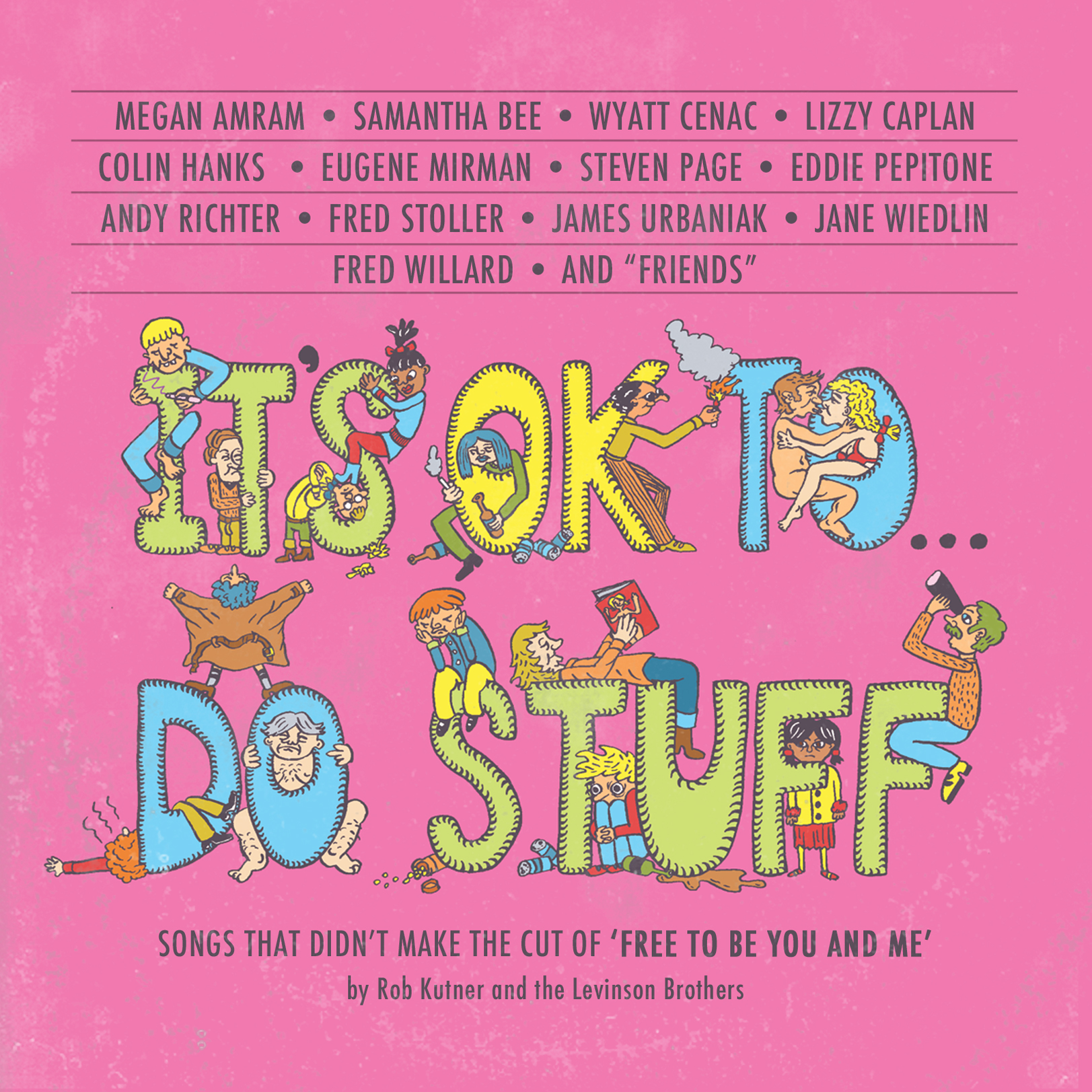 With its songs and stories of individual expression and diversity, Free to Be…You and Me made a strong impact on my childhood in the ’70s. Marlo Thomas’s star-studded music and video production (which included the talents of Mel Brooks, Diana Ross, and Alan Alda, to name a few) continues to speak to kids, today. Its impact goes beyond making all kids feel included in a sometimes fractured world — it has inspired a bunch of talented contemporary comic writers to produce It’s OK to…Do Stuff. As a huge Free to Be… fan I am equally offended and entertained by this parody. This is what happens when we grow up in the “land that I see where the children run free” and end up fans of things like Avenue Q. Produced by Rob Kutner and the Levinson Brothers, and aimed at parents — and their snarky adolescent kids — it features Steven Page (formerly of the Barenaked Ladies) on “Be Yourself…Unless” and Kimmy Gatewood and Colin Hanks (“Divorce Makes a Family Twice as Big”), among other notable contributors.
Tom Riles Asks Kids – What Are You Thankful For?
Tom Riles, dad, comic, filmmaker, and founder of LifeOfDad.com, asks kindergartners: what are you thankful for?. This Thanksgiving, try turning the video camera (or iPhone) on your kids and ask them they’re thoughts. Hopefully the words, “I am thankful for my amazing, selfless parents” will come up.
Night of the Shrinking Bed
By Gregory Keer
It was a cold, eerie night, eight years ago, an evening that still sends chills up and down my spine. My wife and I had endured a fifth straight evening of multiple wake-ups from our newborn. After two feedings, three walks around the house, and four false-alarm cries, Wendy and I trembled with exhaustion. This was compounded by the stress of having just moved to a new home, my starting a teaching gig, and our older sons kicking off a new school year.
Finally, sleep came and, when it did, I went down hard.
That was until I felt a “presence” hovering over me. Dog-tired, I kept snoring. Then I heard a faint wheezing. The wheezing turned to heavy breathing, which got louder and louder. High-pitched moaning pierced my eardrums and my eyes snapped open.
A dark shape stood next to me, holding what looked like an axe!
I screamed. “Ahhhhhh!!!!.”
My wife jumped up and shrieked, “Where’s the baby?”
The figure screamed back. “Dadddeee!!!”
Bolting upright, I recognized the shape as my son, Benjamin. The axe I imagined was his tattered blanket.
My son burst into tears and fell across me in the aftermath of what had been a twisted recreation of the movie scene in which Drew Barrymore sees E.T. for the first time. In this case, I was Drew Barrymore.
“What were you doing standing over me like that?” I said breathlessly.
“I – just – wanted – to – cuddle,” Benjamin blurted between sobs.
And there it was. The dramatic comeuppance for two parents who had long struggled with the issue of a family bed.
Before my wife and I had children, we swore we’d never let our kids sleep with us. We judged others who let their kids in the bed, thinking that kind of arrangement could only create intimacy problems for the couple and therapy sessions for the children.
Sometime later, we found ourselves changing our tune. It began when Benjamin, then almost three and new to a “big boy” bed without rails, started sneaking into our room in the middle of the night. Due to fatigue and the sheer joy of cuddling, we let him snuggle with us for a few hours each night. This went on for a couple of years until Jacob got old enough to leave the crib and want his own time in Mommy and Daddy’s bed.
So we started a campaign to keep the kids on their own mattresses. We told them that they could crawl in with us in the morning, when it was light outside. Jacob, always a deeper sleeper, was easier to keep to the new rule. But we had to experiment with all kinds of tricks to keep Benjamin in his room. Over time, we tried clocks, a sleeping bag on our bedroom floor, extra stuffed animals, a special pillow, and just plain begging with intermittent success.
Then, there was the previously mentioned night of all that wheezing and screaming.
After we all calmed down, I escorted Benjamin to his bed, reminding him of the house rules. A little later, he returned. I got crankier and he went away wailing again. This back-and-forth occurred every 10 minutes, as he tried to gain our sympathy and we used every tactic from yelling to listing all the playdates he was going to lose.
Then, my son Jacob joined the fray, shouting out like a lost child that his pull-up needed to be changed. Jacob fell back asleep but he was replaced by the dog that scratched at the door to go outside and the cat that upchucked a fur ball on the bed. All the while, my wife and I bickered about how to handle the whole mess.
I pleaded with our first-born. I even cried when he cried, asking for mercy on his exhausted father who had to wake up to teach cranky high-school sophomores in the morning.
Finally, with Benjamin as worn out as I was, I found clarity – kind of like a Bugs Bunny horror spoof in which the rabbit realizes the way to stop the monster is by complimenting him (“Gee, Doc, you got really big muscles.”) So, I appealed to Benjamin’s desire to feel like the big boy he was.
“You graduated from kindergarten and now you’re a first grader,” I explained. “It’s time to graduate to sleeping the whole night on your own. You can do this.” I then promised him a reward chart that would track how many nights he could stay in his bed.
Things got a lot better after that. For a while thereafter, Benjamin still crawled into bed with us at 6am or so, but he was proud of himself for becoming more “sleep independent.” Eventually, he stayed in his bed all night and my wife and I got our bed back…That is until kid number two started haunting us.