


-


-

-
Search
-
Recent Posts
- Kryptowährungen Handeln Test – Wo sind kryptowährungen verboten?
- Sichere Krypto Börse – Kryptowährung wovon abhängig?
- Kryptologie Uni Ulm | Welche kryptowährungen haben potenzial?
- Scalping Kryptowährung – Wie viele kryptowährungen gibt es bei coinbase?
- Margin Trading Kryptowährungen Yahoo Finance – Warum steigen kryptowährungen so stark?
Blog Archive
Categories
- Activities With Kids
- Adolescence
- Adulthood
- Aging
- Anger Management
- Apps
- Arts Education
- Babies
- Blog
- Books
- Boys to Men
- Breastfeeding
- Camp
- Cars
- Celebrity Dads
- Charity
- Child Development
- Children's Music Reviews
- Columns by Family Man
- Contests
- Creativity
- Dating Dad
- Death
- Divorced Dads
- Education
- Ethics
- Family Communication
- Family Man in the News
- Family Man Recommends
- Family Music
- Family Music Reviews
- Father's Day
- Featured Moms & Dads
- Film
- Food
- Free Stuff
- Friendship
- Gender
- Graduation
- Grandparents
- Halloween
- Health
- Helping Kids Understand Loss
- Holidays
- Humor
- Internet Safety
- LifeofDad.com
- Love and Courtship
- Marriage
- Morals
- Mother's Day
- Movies
- Music
- Newborns
- Over-parenting
- Parenting Stress
- Perspective
- Pets
- Politics
- Protecting Children
- Safety
- School
- Sex Ed
- Siblings
- Single Fathers
- Social Action
- Special Needs
- Sports
- Sweepstakes & Promotions
- Talking About Disasters
- Teens
- Top Ten Lists
- Travel
- Traveling With Kids
- TV
- Tweens
- Uncategorized
- Values
- Vasectomy
- Video
- What Dads Need to Know
- Work-Family Balance
Recent Comments
- Beth on The One That Ends With Hope
- Judi Feldman on The Brass Tacks of Music Education
- Fran Keer on A Road Well Traveled
- norman edelson on A Road Well Traveled
- Justin Rogan on The Gift of Boredom
- © 2026 - Gregory Keer. All rights reserved.
Daily Archives: October 9, 2012
Night of the Shrinking Bed
By Gregory Keer
It was a cold, eerie night, eight years ago, an evening that still sends chills up and down my spine. My wife and I had endured a fifth straight evening of multiple wake-ups from our newborn. After two feedings, three walks around the house, and four false-alarm cries, Wendy and I trembled with exhaustion. This was compounded by the stress of having just moved to a new home, my starting a teaching gig, and our older sons kicking off a new school year.
Finally, sleep came and, when it did, I went down hard.
That was until I felt a “presence” hovering over me. Dog-tired, I kept snoring. Then I heard a faint wheezing. The wheezing turned to heavy breathing, which got louder and louder. High-pitched moaning pierced my eardrums and my eyes snapped open.
A dark shape stood next to me, holding what looked like an axe!
I screamed. “Ahhhhhh!!!!.”
My wife jumped up and shrieked, “Where’s the baby?”
The figure screamed back. “Dadddeee!!!”
Bolting upright, I recognized the shape as my son, Benjamin. The axe I imagined was his tattered blanket.
My son burst into tears and fell across me in the aftermath of what had been a twisted recreation of the movie scene in which Drew Barrymore sees E.T. for the first time. In this case, I was Drew Barrymore.
“What were you doing standing over me like that?” I said breathlessly.
“I – just – wanted – to – cuddle,” Benjamin blurted between sobs.
And there it was. The dramatic comeuppance for two parents who had long struggled with the issue of a family bed.
Before my wife and I had children, we swore we’d never let our kids sleep with us. We judged others who let their kids in the bed, thinking that kind of arrangement could only create intimacy problems for the couple and therapy sessions for the children.
Sometime later, we found ourselves changing our tune. It began when Benjamin, then almost three and new to a “big boy” bed without rails, started sneaking into our room in the middle of the night. Due to fatigue and the sheer joy of cuddling, we let him snuggle with us for a few hours each night. This went on for a couple of years until Jacob got old enough to leave the crib and want his own time in Mommy and Daddy’s bed.
So we started a campaign to keep the kids on their own mattresses. We told them that they could crawl in with us in the morning, when it was light outside. Jacob, always a deeper sleeper, was easier to keep to the new rule. But we had to experiment with all kinds of tricks to keep Benjamin in his room. Over time, we tried clocks, a sleeping bag on our bedroom floor, extra stuffed animals, a special pillow, and just plain begging with intermittent success.
Then, there was the previously mentioned night of all that wheezing and screaming.
After we all calmed down, I escorted Benjamin to his bed, reminding him of the house rules. A little later, he returned. I got crankier and he went away wailing again. This back-and-forth occurred every 10 minutes, as he tried to gain our sympathy and we used every tactic from yelling to listing all the playdates he was going to lose.
Then, my son Jacob joined the fray, shouting out like a lost child that his pull-up needed to be changed. Jacob fell back asleep but he was replaced by the dog that scratched at the door to go outside and the cat that upchucked a fur ball on the bed. All the while, my wife and I bickered about how to handle the whole mess.
I pleaded with our first-born. I even cried when he cried, asking for mercy on his exhausted father who had to wake up to teach cranky high-school sophomores in the morning.
Finally, with Benjamin as worn out as I was, I found clarity – kind of like a Bugs Bunny horror spoof in which the rabbit realizes the way to stop the monster is by complimenting him (“Gee, Doc, you got really big muscles.”) So, I appealed to Benjamin’s desire to feel like the big boy he was.
“You graduated from kindergarten and now you’re a first grader,” I explained. “It’s time to graduate to sleeping the whole night on your own. You can do this.” I then promised him a reward chart that would track how many nights he could stay in his bed.
Things got a lot better after that. For a while thereafter, Benjamin still crawled into bed with us at 6am or so, but he was proud of himself for becoming more “sleep independent.” Eventually, he stayed in his bed all night and my wife and I got our bed back…That is until kid number two started haunting us.
What Dads Need to Know: Roughhousing Benefits
By Heather Shumaker
My neighbor is a stay-at-home dad. When he heard I had written a parenting book – one that included chapter titles like “Ban Chairs – Not Tag” and “Bombs, Guns, and Bad Guys Allowed,” he perked right up. “I was always being told I was “bad” as a boy because I needed to move my body,” he said.
Movement, action and rough physical play are an essential part of early childhood, for boys and girls alike. Instead of banning high energy, find ways to welcome it.
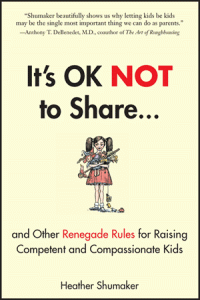 Here’s an excerpt from the book It’s OK Not to Share…And Other Renegade Rules for Raising Competent and
Compassionate Kids (Tarcher/ Penguin, 2012. Reprinted with permission). The book contains a whole section called “Running Room” which explores action, power and movement. This chapter celebrates roughhousing.
Renegade Rule 17 – Only punch your friends
Dan punches Leo, and Leo punches right back.
Nearby, an adult looks on, but doesn’t interrupt. These two four-year-olds are having fun. Dan and Leo are both wearing pint-sized boxing gloves, purple and red, and standing barefoot on a tumbling mat. They are giggling and having a marvelous time.
Renegade Reason – Roughhousing—even play boxing—is social and healthy. But it has no place if someone’s angry.
When I told a fellow mother that I was writing a book which included boxing at preschool, she was shocked. “Boxing? You’ve got to be kidding me. I spend my time trying to keep their hands OFF each other!”
That can be a problem. Young kids are physical creatures. They like body contact and have a deep need for touch. Especially since verbal skills are still developing, one of the ways children show interest in a friend is through physical contact, sometimes hugs, sometimes play fights.
Lee and Janet, the founders of my childhood preschool noticed this. They watched kids play and saw how much young kids liked to wrestle. Children would roll around together like little lions or puppies. They thought: if kids want to play that way there must be a reason. Well, why not? Lee and Janet equipped rooms with wrestling mats and boxing gloves. Rough-housing games blossomed into a 40-year tradition at the School for Young Children.
Rough-housing games, like boxing and wrestling, give kids outlets for high energy and boost friendships. But only when everyone is having fun. If someone’s angry, it’s not a game. Rough-housing is not a way to settle a conflict. Games should be between willing partners who are in a playful mood.
What’s more, it turns out that boisterous play like preschool boxing is not only a legitimate way to have fun, it also plays a positive, important role in child development.
Renegade Blessings
Rough-and-tumble play helps our kids grow on many levels. A child can learn:
– I’m strong and powerful.
– It feels good to use my body actively.
– I can make friends and take on new challenges.
– I can set limits on other people and stop something I don’t like.
– I can listen to my friends and know when to stop.
– I can cope, even if I get hurt a little bit.
– If someone gets hurt, we can make new rules so it doesn’t happen again.
Why it works
Whether it’s called rough-and-tumble play, boisterous play, horse play, puppy play, or rough-housing, this kind of play is a vital part of childhood. Rowdy puppy play helps bodies and brains develop. When two kids tussle on the floor, or roll around together, they are showing the need to wrestle. If we say ‘no’ to rough play, we are thwarting this need. Instead of issuing a ban (Get your hands off of him! Quit hitting your brother. I don’t want to see any bodies touching.) think how you can best meet this age-old need.
Horse play may look like out-of-control goofing off, but it serves a deeper purpose. Studies by Dr. Jaak Panksepp show that rough-and-tumble play helps to develop the brain’s frontal lobe including the prefrontal cortex. This is the area of the brain that commands Executive Function, controls impulses and regulates behavior. The more the prefrontal cortex is developed, the better kids do in all areas of life, whether it’s social, emotional, or academic. On-going research by Dr. Adele Diamond and others suggests that Executive Function is the top predictor of kids’ success.
Roughhousing Benefits
– Friendship
– Energy outlet
– Chance to experience power
– Impulse control
– Risk-taking
– Building brain power
– Body and spatial awareness
– Need for motion
– Need for physical touch
– Practice setting limits on peers
– Negotiating skills
– Building trust with peers
– Self-esteem
– Reading emotions
– Showing empathy
– Joy
Since this part of the brain is so important, is it really any surprise that kids develop it by doing simply what kids do best? Rolling about the floor and tussling with squawks of high excitement. Rough-and-tumble play must be welcomed.
As early educator Dan Hodgins puts it: “It’s just as important to rough house with kids as to read them a story.”
More on welcoming rough-and-tumble play into your family or classroom in It’s OK Not to Share, including:
– staging a wrestling match
– getting hurt
– setting kid-based rules
– winners and losers
– power actions
– welcoming movement
– benefits of risk
Heather Shumaker is the author of It’s OK Not to Share…And Other Renegade Rules for Raising Competent and Compassionate Kids (Tarcher/ Penguin, 2012). She’s a journalist, blogger, speaker and mother of two young children, whose work has appeared in Huffington Post, New York Post, Parenting, Pregnancy and Organic Gardening. She’s a frequent guest on radio and TV shows about writing and parenting, and blogs at Starlighting Mama. You can learn more about Heather’s book at www.heathershumaker.com.
Family Man Recommends: Children’s Music Reviews for October
Reviewed by Gregory Keer
 We in the Keer house have been fans of Charity and the JAMBand since my two oldest were grooving to 2006’s Rock Your Socks Off. Charity Kahn and her bandmates perform songs with lyrics of peace and family togetherness layered with any number of funky, dreamy, rocking, and rolling sounds. Disarming listeners with her with youthful voice, Charity has a drive in her music that rings with such genuine belief in the Family Values her songs speak of that it’s hard not to be transported to an idyllic state of mind. Among the 13 diverse tracks are the Lenny Kravitz-like propulsion of the title track, the folk lilt of “Lovingkindness,” the Bangles-esque “Valentine,” the electronic jazz-rock of “Flower of Power,” and the bluesy anthem of “We Are the Ones.” The rhythms and song craft are so good on this album, it’s one of those discs adults can shamelessly listen to even when the kids aren’t around.
There seems to be a resurgence in family-music projects that aim to teach as well as entertain. Sometimes, it comes off forced and clunky, but The Mighty Sky transcends most standards with its fluid blend of song and science. Nashville-based singer-songwriter Beth Nielsen Chapman — who has written pieces for such luminaries as Bonnie Raitt, Neil Diamond, Trisha Yearwood, Elton John, and Emmylou Harris — offers an eclectic mix of sonic styles to accompany the songs she’s written with Annie Roboff and lyricist Rocky Alvey, the Director of the Vanderbilt Dyer Observatory. From the atmospheric title tune and the do-wop-tinged “The Moon” to the rockabilly-lighted “Rockin’ Little Neutron Star” and the earthy “Zodiacal Zydeco,” this album inspires interest and learning about astronomy as it provides musical uplift.
David Tobocman is a clever songwriter (he currently composes for the cartoon Robot and Monster), but he takes a simple, straightforward approach to making music for young kids. Light rock, bluegrass, and folk underpin Tobocman’s songs on Escalator, from the upwardly mobile tune for which the album is named and the wildly imaginative “Custom Family Spaceship” (which suggests an intergalactic family vacation) to the down-to-earth “Gonna Be a Garbage Man” and the optimistic “Peace Sign.”
Beauty abounds amidst the Blue Clouds of Elizabeth Mitchell’s newest album. With grace and quiet purity, the Smithsonian Folkways recording artist interprets wide-ranging classic songs from the likes of David Bowie (“Kooks”), Bill Withers (“I Wish You Well”), Jimi Hendrix (“May This Be Love”), and Van Morrison (“Everyone”). While strings, flutes, and the angelic voices of Mitchell and her daughter Storey (Mitchell’s husband, Daniel Littleton, plays guitar and other instruments, here) populate the music, the artwork of Remy Charlip characterizes the CD cover and booklet and the words of Brian Selznick (the author of The Invention of Hugo Cabret) introduce this affecting project.
We conclude this month’s children’s music reviews with multi-award-winner Ben Rudnick, who is on his tenth family-music album, but the vitality of the songs on this recording prove the singer-songwriter has yet to run out of good ideas. Catch such fine tunes as the rootsy “A Little Boogie,” the island-hued “Where Are the Dragons,” and the cowboy-swaying “Scribbling.”
Dad Music Video Has Fathers Singing “A Little Mermaid” Classic
This dad music video shows the transformative power of being a dad. At LifeOfDad.com, firefighters, Marines, cops, construction workers, scientists and other fathers belt out “Part of Your World” from the decidedly not-macho film A Little Mermaid. Technical difficulties left my multi-octave operatic part in this on the cutting-room floor, but these guys bring it home just fine.